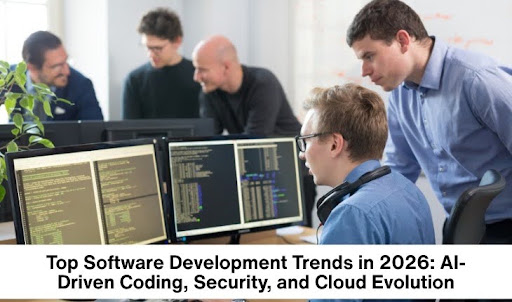
Top Software Development Trends in 2026: AI-Driven Coding, Security, and Cloud Evolution
Software development is changing rapidly due to digital transformation and new technologies. Organizations are now putting their money into new applications that give them better productivity, security, and customer experience. The industry statistics show that the Global Software Market (Mercado Global de Software) is growing as firms use artificial intelligence, cloud platforms, and high-level software engineering in order to compete. In 2026, software development will emphasize intelligent automation, secure coding, large-scale cloud infrastructure, and quicker delivery cycles for companies to innovate.
AI-Driven Coding Accelerates Software Development
The development of artificial intelligence technology has influenced the software engineering industry significantly. AI tools help programmers with the writing of high-quality code, automation of monotonous tasks and complications detection, thus are considered as a great aid for developers that increases productivity. Instead of replacing the developers, AI makes their work easier and gives them more time to deal with complicated business issues.
Machine learning has developed algorithms that enable carrying out a thorough analysis of existing code and making recommendations concerning the reduction of technical debt. AI technology advises automated tests on issues that could occur before launching the applications that permit software professionals to meet high-quality performance criteria.
The integration of AI tools into the companies is due to the development of AI technologies and their stepwise implementation into programmer’s work processes related to the creation of software.
Cloud Evolution Supports Scalable Applications
Cloud computing is one of the biggest forces reshaping software development in our time. Rather than being trapped on bricks and mortar, companies are starting to move from traditional on-premises infrastructures to scalable, more flexible, and cheaper solutions that run in the cloud.
Nevertheless, the cloud solutions allow software developers to bring applications faster on the market through CI/CD technologies.
The container technology and microservices concept has taken over the common practice of cloud-native processes already. It enables the companies to build modular applications due to which, any module can be updated or changed whenever business needs it.
Security Becomes a Core Development Priority
Cybersecurity is not only considered as the last process in software development anymore. At present, security has become included in all stages of development processes.
Organizations all over the world have widely implemented the principles of DevSecOps which makes security a necessary part of every phase of software development. The use of several technologies for automatic vulnerability scanning, secure code analysis, identity management, and compliance monitoring helps to detect all risks before their application.
As for developers of software solutions, they make use of multi-factor authentication, encryption, API security, and various zero-trust security models to protect sensitive data from a variety of cyberattacks.
With growing demands on regulation, the issue of secure software development has become essential for maintaining customer loyalty and protecting data of businesses at the same time.
The Global Software Market (Mercado Global de Software) Continues to Expand
Corporate initiatives for digital transformation are leading to an increase in investments in business applications and software systems. The Global Software Market, or Mercado Global de Software, is experiencing sustained growth as companies modernize their systems by developing and using cloud-based software.
Companies are choosing to use enterprise resource planning (ERP), customer relationship management (CRM), cybersecurity solutions, collaboration systems and data analysis software for enhanced productivity and effective decision-making.
There are many establishments that develop scalable software that can be used on a subscription basis in their specific sector.
With progress in the sector, companies will keep investing in software development as the future of their operations.
Low-Code and No-Code Platforms Gain Momentum
Low-Code and No-Code Development Many readers have expressed an interest in software development with the increasing need for digital solutions. They are platforms that allow users of very little experience to create applications using visual models and components which have been built-in before.
Low-code platforms assist experienced developers by accelerating time to delivery and automating repetitive coding tasks and streamlining the application development process. It helps the organisations in accelerating the digital product launch with lesser development cost.
While enterprise systems are still complex and often require professional software engineers, low-code development represents a much-needed balance for internal business applications — specific kinds of workflow automation and rapid prototyping.
By 2023, the role of low-code technologies will grow as organizations look for opportunities to accelerate digital transformation.
Data-Driven Development Improves Software Quality
From operating in silos, to breaking those kinds of walls — data has become a piece of digital real estate through the software development lifecycle. Development teams are now using analytics to understand how users interact with their applications, track application performance and discover areas of improvement.
For instance, real-time monitoring tools offer insights into the reliability of applications, user engagement and even system performance. This information aids developers to maximize features, remedy issues faster, and deliver greater digital stories.
Additionally, predictive analytics allows organizations to be able to see when something may go wrong before it disrupts the end user thus increasing software stability and customer satisfaction.
When data is integrated into every aspect of the development cycle, businesses are creating applications that better meet customer needs and organizational goals.
Collaboration Drives Faster Innovation
Collaboration between developers, designers, quality assurance teams, cybersecurity specialists to business stakeholders is an indispensable part of modern software development. Lean and agile works continuously communicate, develop iteratively, and gain constant feedback from customers all through the project life cycle.
Many teams work from different countries, and so tools such as collaboration platforms, version control systems, and automated project management work well with distributed development. Such technologies offer enhanced transparency whilst also reducing delays from traditional development models.
In addition, collaboration across functions ensures that successful software products strike a balance between technical requirements and real business value.
Sustainability Influences Software Development
Sustainability is starting to gain more attention in the software industry. Companies giving their best to make applications energy efficient, and also boost server utilization for environmentally friendly cloud operations.
Optimized coding, optimized databases and cloud resource management bring down the operational cost with the least impact on the environment. With other sustainability initiatives hitting the ground, green software engineering is one of the trends that’s gaining more attention.
Platforms are moving towards data centers powered by renewable energy and infrastructure for efficient resource management to help build responsible software.
Being data-driven is the future — and sustainable software engineering will be a vital part of the digital transformation for organizations as environmental awareness increases & data becomes a premium.
The Future of Software Development
Intelligent, automated, secure and adaptable software development can be expected in 2026. From the continuous improvement of developer productivity due to AI, the greater ease of scale offered by cloud platforms, and a dire need for high levels of cybersecurity across every step throughout the development lifecycle.
Player organizations to modern development practices, invest in skills and talent-pool as well as emerging technologies will be smarter in devising innovative digital solutions which are capable of being ahead of the growing expectations of customers.
Writing Code will NOT be the Future of Software Development. It will focus on designing secure, scalable, and intelligent applications that will handle sustainable business growth in an increasingly connected world.
Conclusion
Software development continues to evolve as organizations invest in artificial intelligence, cloud technologies, secure engineering practices, and data-driven innovation. These trends are helping businesses deliver better digital experiences while improving operational efficiency and long-term competitiveness.
The continued growth of the Global Software Market (Mercado Global de Software) highlights the increasing importance of modern software solutions across industries. As organizations accelerate digital transformation, understanding emerging market trends becomes essential for making informed technology investments. For comprehensive market intelligence, future forecasts, and in-depth industry analysis on the Global Software Market (Mercado Global de Software), Informes de Expertos provides valuable insights that help businesses navigate the rapidly evolving software landscape